The Twelve Palaces of Zi Wei Dou Shu: What the Other Eleven Watch Besides the Life Palace
The first time I looked at a Zi Wei chart, someone pointed at the lower right corner of the chart and said: "Your wealth palace is not good."
At that point I could not even find the Life Palace, so all I could do was nod.
Only later did I understand that the problem with that sentence was not whether it was right, but that it had skipped the way an entire chart is read.
The twelve palaces are a fixed framework
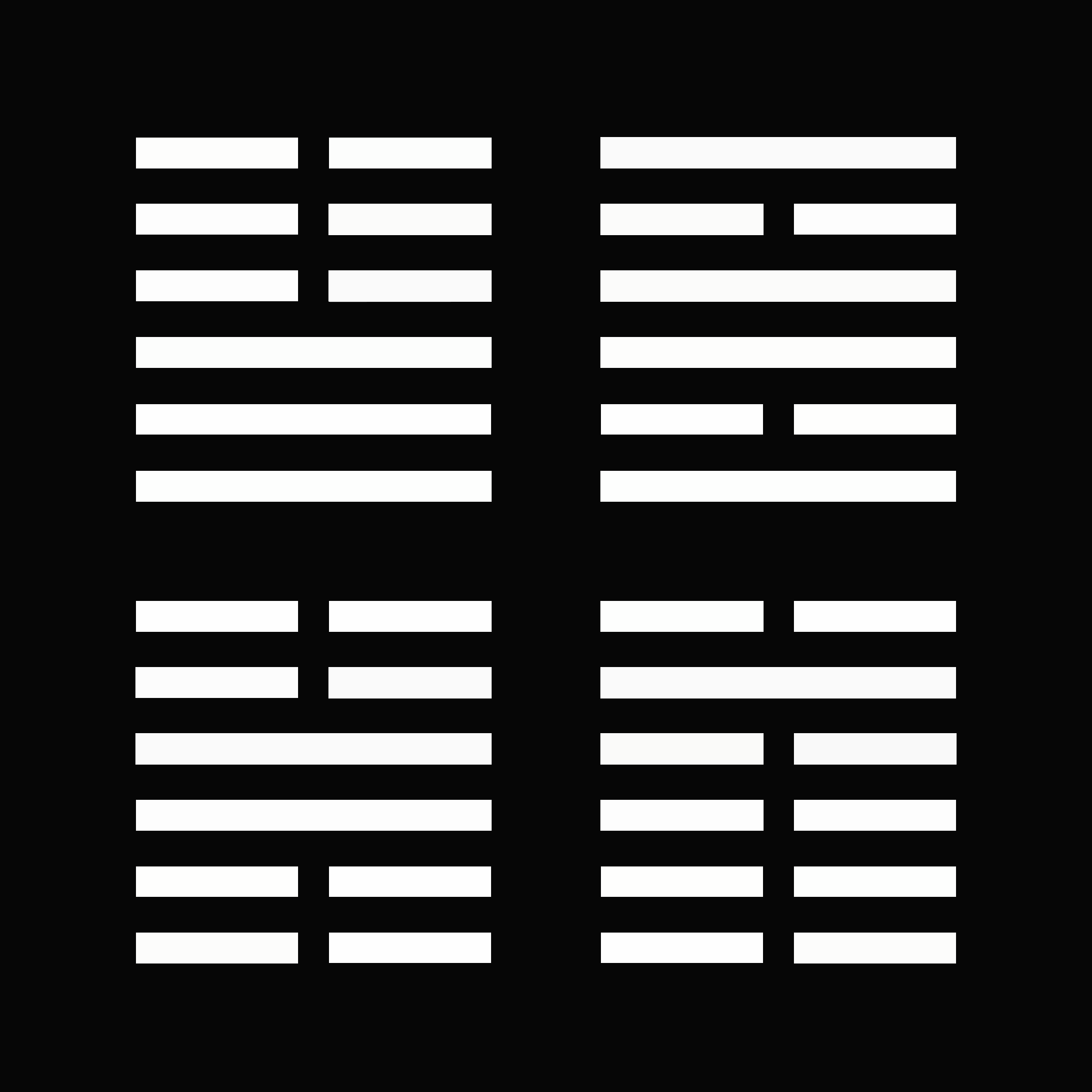
A Zi Wei Dou Shu chart is divided into twelve palaces, laid out with stems and branches as warp and weft (Source 1). The names of the twelve palaces are fixed: Life Palace, Siblings, Spouse, Children, Wealth, Health, Travel, Friends (formerly called Servants), Career, Property, Fortune, Parents.
When the chart is cast, the Life Palace and the Body Palace are fixed first; the position of the Zi Wei star is then calculated from the Na Yin five-phase number of the Life Palace; the remaining principal stars are determined one by one from the position of Zi Wei, fourteen principal stars in all, Zi Wei included (Source 1). So the whole chart is "framework first, stars second", and the meaning of a star has to be read inside its palace.
The twelve palaces begin at the Life Palace and run in a fixed sequence anticlockwise — that sequence belongs to the framework itself and does not change from person to person. The only things that change are which palace a star falls into, and what the heavenly stem of that palace is.
How to read it: relations first, stars second
When reading a chart, the San He system (also called the Southern school) takes San Fang Si Zheng as its core: a palace is not read on its own — the palace opposite it, and the two palaces that form a triangle with it, are read in as well (Source 1).
By analogy: if the Life Palace is "me", then the palace opposite is "my external world"; the Wealth Palace and the Career Palace form a pair, one governing how money comes in, the other governing how work is done. To look only at the Wealth Palace and pronounce on someone's finances is like judging a person's health from one hand.
Three common mistakes in reading a chart
The first is treating the palaces as a scorecard. The twelve palaces carry no scores; they are twelve windows for observation. Stars looking unpromising in one palace does not mean that side of life is bad; often it only means "things here will take a bit more jostling".
The second is taking an empty palace for something missing. When a palace holds no principal star it is called an empty palace, and the usual technique is to borrow the principal star of the opposite palace — it is not "this part of your fate is missing".
The third is treating star names as labels of good or ill fortune. A star name describes a quality, not a verdict. The same star in a different palace, or sharing a palace with different stars, says something quite different.
At the beginning I drew the twelve palaces as a circle and stuck it above my desk, and every time I read a chart I made a note in the corresponding palace. It took two months of that before I gradually got used to it: find the palace first, then look at the stars, and only at the end look at the relations between them. Reverse that order and it easily turns into "pick a star and tell a story".
Tools on this site (for entertainment)
This site offers an entertainment-oriented process: describe your situation clearly → get a method suggestion → read the chart and the interpretation → export the result if you want to keep it. The content is for entertainment and self-reflection only; it promises no prediction and is not decision advice.
This article was last checked on 19 September 2026. Traditional divination has many schools and a long history, and their formulas and versions do not fully agree; the text relies on publicly verifiable sources, and for dates and calendars please refer to the latest official publication.
Disclaimer: This article covers traditional culture and folk custom. It is for entertainment and self-reflection only, and does not constitute medical, psychological, investment, legal or marital decision advice. Please do not submit sensitive personal information such as ID numbers or detailed addresses. If you experience persistent insomnia, anxiety or physical discomfort, please consult a doctor or a qualified professional.
Sources
- "Zi Wei Dou Shu" (《紫微斗数》) — Wikipedia: https://zh.wikipedia.org/zh-cn/紫微斗数 (accessed 19 September 2026)
- Method page on this site: Zi Wei Dou Shu Chart: https://zhanbumizhi.top/en/methods/ziwei (accessed 19 September 2026)